
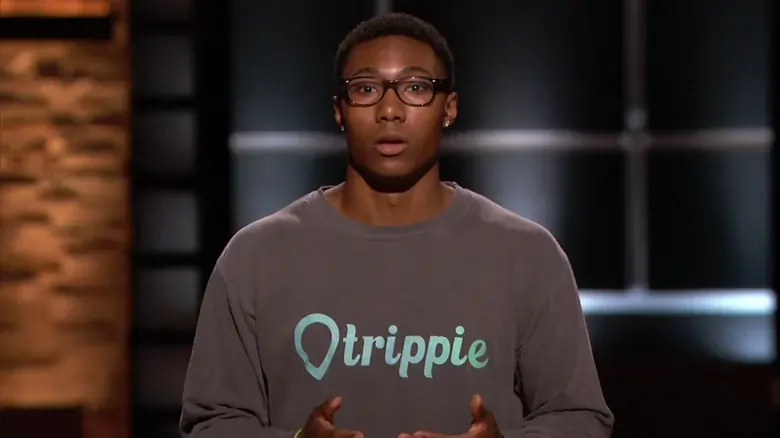
Ryan Diew was 21 years old when he walked onto the Shark Tank set in 2017. He was a recent Colgate University graduate, a former college basketball player, and the founder of Trippie – an app designed to help travellers navigate large airports. He left without a deal, visibly heartbroken. Trippie is now valued at $3.5 million, generating $3 million a year, and operating in 120 airports worldwide.
The Pitch
Diew asked for $100,000 for 10% equity, valuing the business at $1 million. Trippie had 179 users and worked in just four airports. Mark Cuban said it felt more like a feature than a standalone business. When Diew mentioned he didn’t have a rich uncle to help fund the app, Robert Herjavec cut him off, pointing out that his own father worked in a factory and his mother was a receptionist. No sympathy, no deal.
Diew left in tears. He has spoken about it openly since, saying he let his emotions get the better of him and that it was a lesson he carried forward. Worth noting: before Shark Tank, he had turned down job offers from Google to work on Trippie full time, and had won every pitch competition he had entered. The Shark Tank stage was his first real loss.
The Shark Tank Effect
The episode aired on October 1, 2017. In the hours that followed, Trippie was downloaded nearly 12,000 times. The app briefly ranked 21st in the travel category on the App Store. The surge was so sudden that Diew’s web server crashed under the traffic.
No deal, no money but the exposure proved the demand was real.
Growth After the Show
Diew took the feedback seriously rather than dismissing it. He expanded from four airports at filming to 16 within weeks of the episode airing – covering airports that between them accounted for 82% of all US domestic air travel. That number has since grown to 120 airports worldwide, with the app available free on both iOS and Android.
Revenue followed. By 2023, Trippie was generating around $3 million annually, more than three times what Diew was asking for the entire company on the show. He also won a $10,000 prize at a Tech Done Right pitch competition in Oakland and was recognised as one of 42 Silicon Valley’s most influential African Americans in tech.
What Nobody Mentions About the Base Ventures Story
Most articles note that Diew joined Base Ventures as an Entrepreneur in Residence. What they leave out is how it actually happened.
After the show, Diew was sleeping on an air mattress at his parents’ house in Oakland and driving for Lyft part-time to cover expenses while continuing to build Trippie. Base Ventures let him work on the app from their office couch. Over time, as he proved himself, they started asking him to review pitches, write deal memos, and run due diligence on companies they were considering. He was eventually promoted to Partner.
In his own words: “Base Ventures allowed me to start working on Trippie as an Entrepreneur in Residence on their couch. Then, they started asking me to listen to more pitches, and do deal memos, and do due diligence on companies; later, they promoted me to Partner.”
That’s a meaningfully different story from “he joined a VC firm.” He earned his way in, and he’s still listed as Trippie’s founder, CEO, and iOS engineer, meaning he coded the app himself and still maintains it.
Where Things Stand Now
Trippie’s website went dark by mid-2024, though the app remained live and active. Social media slowed significantly around 2021, a period that coincided with COVID-19 gutting air travel globally – an obvious vulnerability for an app built entirely around in-airport navigation.
Beyond the app and Base Ventures, Diew also coaches youth basketball back in his hometown of Oakland. In a 2022 interview, he described indoor navigation as the future of the space, framing it as breaking navigation down from the “places” level to the “things” level. Whether Trippie is the product to own that opportunity long term is an open question, but Diew is clearly not standing still.
The Verdict
The Sharks were right that Trippie wasn’t ready in 2017. What they couldn’t factor in was what Diew would do with the rejection. He expanded to 120 airports, hit $3 million in revenue, built a career as a venture capital partner, and did most of it while sleeping on an air mattress and driving Lyft.
By his own account, the Shark Tank experience gave him “the hunger to keep building.” For a 21-year-old who had never lost a pitch before, that might have been worth more than the $100,000 he was asking for.
