
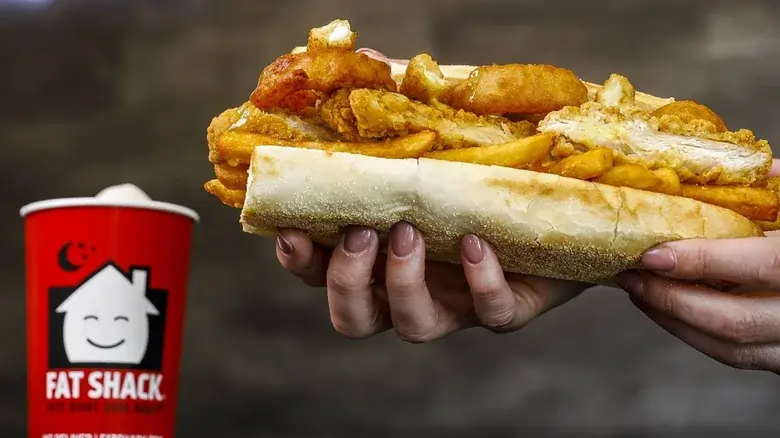
Fat Shack is one of Shark Tank’s quieter success stories. Founder Tom Armenti started the late-night sandwich joint in 2010 with just $5,000. By the time he and partner Kevin Gabauer walked into the Tank in 2019, they had 11 locations and a deal-closing pitch that landed $250,000 from Mark Cuban. Today the brand has grown to around 30 locations, pulls in roughly $20 million in revenue, and is worth an estimated $50 million.
The Founder Behind the Grease
Tom Armenti never held a regular job before he built a fast-food chain. While studying at The College of New Jersey, he noticed his campus had no decent late-night food. Students at nearby Rutgers, meanwhile, lined up at “grease trucks” for oversized Jersey-style fat sandwiches stuffed with every fried food imaginable. Armenti saw a gap and decided to fill it himself.
His partner came later. Kevin Gabauer, Armenti’s college friend, joined the business in 2013 once it had relocated to Colorado. Gabauer helped reorganize the menu, refresh the brand, and simplify operations.
Fat Shack’s Founding Story
In February 2010, Armenti struck a deal with a local bagel shop owner. The shop closed in the afternoon, so Armenti rented the storefront and kitchen for the night, running his own restaurant from the evening until 4 a.m. He blanketed the campus with paper menus and delivered fat sandwiches to hungry students for an average check of around $18.
The signature product was the fat sandwich, a roll loaded with chicken fingers, French fries, mozzarella sticks, onion rings, and sauce. It was unapologetically indulgent and aimed squarely at college partiers who wanted something filling after a night out.
In August 2011, he opened the first full-size Fat Shack in Fort Collins, Colorado, home to Colorado State University. Within six months a second location opened in Boulder, and by February 2015 the company launched its first franchise near the University of Denver. The franchise model became the engine of everything that followed.
The Shark Tank Pitch
By the time Armenti and Gabauer reached the Season 10 finale, Fat Shack already had 11 locations, two company-owned and nine franchised, and lifetime sales topping $22 million. They came in asking for $250,000 in exchange for 7.5% equity, valuing the company at around $3.3 million.
The pitch leaned into the humor. The founders built one of their towering sandwiches on stage and handed samples to the Sharks. Lori Greiner asked about the calorie count, and Armenti admitted the sandwiches ranged from 700 to a massive 2,000 calories. Greiner passed, as did Robert Herjavec.
Cuban initially balked at investing in a deep-fried sandwich chain. But the numbers and the franchise model won him over. When Armenti asked him to do the deal at 15% equity, Cuban agreed, sealing it with the line, “Let’s go get fat.” The founders walked away with $250,000 for 15% of the business.
Fat Shack’s Valuation
When Cuban invested $250,000 for 15% of Fat Shack in 2019, the deal valued the company at roughly $1.7 million. The brand has grown significantly since then. Fat Shack now has around 30 locations and generated $20 million in annual revenue in 2025 as reported by BusinessInsider.com.
Restaurant franchise brands of this size can often be valued at around two to three times annual revenue, depending on profitability, growth, brand strength, and franchise economics. Based on that range, Fat Shack’s estimated net worth is around $40 million to $60 million, with a midpoint estimate of $50 million.
That would make the company worth more than 20 times its implied valuation from Cuban’s original deal.
What Happened After Shark Tank
The deal was real, and it stuck. Within 48 hours of the episode airing, Fat Shack received over 3,000 franchise inquiries. Rather than accepting every applicant, Armenti and Gabauer became selective with franchisees to protect the brand as it expanded.
Cuban also helped the company grow in Texas, particularly around Fort Worth. When the manager of the Fort Worth location left, Armenti stepped in himself, working late-night shifts, frying food, and cleaning to keep the store running.
Fat Shack’s growth has been steady rather than explosive. The chain expanded its store count by a third in 2020, and Restaurant Business named it a “Buzzworthy Brand” in 2021.
The menu has also expanded beyond fat sandwiches to include burgers, cheesesteaks, wings, shakes, and value bundles. The brand has kept its over-the-top identity too, including a “5K Challenge” where customers can win a $50 gift certificate by eating 5,000 calories of Fat Shack food in 15 minutes.
In February 2025, Fat Shack celebrated its 15-year anniversary. As of mid-2025, it operates around 30 locations across 13 states, including Colorado, Florida, Georgia, Illinois, Kansas, Missouri, Nevada, Oklahoma, Oregon, Pennsylvania, Tennessee, Texas, and Washington.
Newer openings include Melbourne, Florida, and Sioux Falls, South Dakota.
