
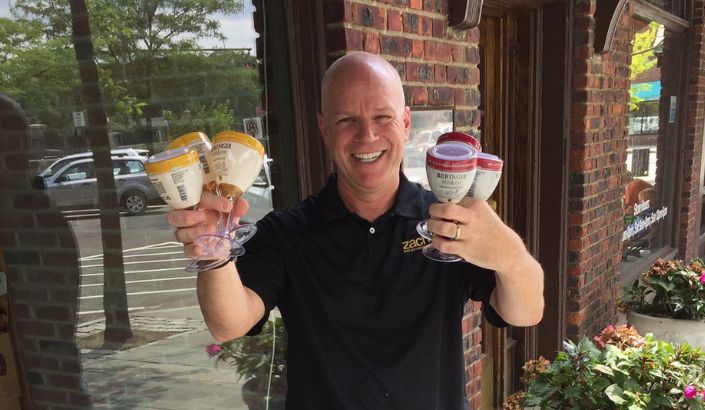
Zipz was ahead of its time in popularising single-serve wine in creative containers. Its founder, Andrew McMurray, pitched the concept on Shark Tank and secured one of the largest investments in the show’s history. Despite a promising start, the business failed to turn a profit. Zipz Wine was once valued at $25 million but is now worth nothing as it went out of business.
Andrew McMurray
Andrew McMurray is from Scarsdale, New York. He studied Business, Management, and Marketing at UMass Amherst, graduating in 1990.
Three years later, Andrew became the Vice President of Zachys Fine Wine, a position he still holds today. Although he appeared on Shark Tank by himself, he ran the company with his partner J. Henry Scott.
Scott is an engineering graduate from Rutgers University. In 2005, he landed his first job as a producer at indie film company HD Productions, before moving into corporate development at AirSpa, a health and wellness enterprise, in 2010.
How Zipz Came to Life
Zipz began when McMurray and Scott met at Citi Field, New York. Andrew shared his idea for single-serve wine packaging and Scott was immediately on board. They teamed up with Fetzer Vineyards to get the business off the ground.
The startup launched in 2012, but the initial designs were flawed – early prototypes lacked proper wrapping to prevent leakage. This inspired Scott to create a dual-function coaster and lid.
The final product was a plastic vessel shaped like a wine glass, opened simply by unwrapping and unscrewing the top. Fetzer Vineyards helped get the product into stadiums and generated over $650,000 in sales before Shark Tank.
Their Rise and Fall After Shark Tank
Zipz Wine secured one of the biggest ever deals in Shark Tank history but unfortunately, the company’s future was not as bright as the founders predicted.
The post-Shark Tank period began encouragingly. Zipz got around $2 million in sales following its appearance on the show, a significant jump from the $600,000 it had before. With O’Leary’s help, the product reached over 1,200 locations across the United States and was also sold through online platforms.
However, the Costco opportunity (a key condition of O’Leary’s deal) never materialised. McMurray recalled that a leaky wine glass put an end to the possible Costco arrangement. Behind the scenes, profitability remained elusive.
Competition was fierce, production costs were high, and consumer habits proved hard to shift. People were accustomed to cans and bottles. The premium single-serve glass format didn’t catch on for mass-market appeal.
The company pivoted to a B2B model, rebranding as Zipz Packaging and licensing its patented glass design to other wine brands rather than selling direct to consumers. But even this wasn’t enough.
Zipz’s Instagram, Facebook, and Twitter pages have not been updated since 2016. Since 2021 the company website has not been updated, and Crunchbase reported the business closed. By 2023, Zipz Wine was confirmed to be defunct with no active operations.
O’Leary, who lost his $2.5 million investment, was characteristically blunt about the outcome. He stated: “If you can’t make money after 36 months, and there’s no path to making money, it was a hobby, not a business.” As for McMurray, he has returned his focus to Zachys, where he remains an active and prominent figure in the wine industry.
Zipz’s Shark Tank Pitch
It was a promising product, with about 25 seasoned investors lining up to invest $8.5 million. Even with this, the founders wanted help from the investors on Shark Tank. In 2014, Andrew McMurray appeared on season six of the show, offering 10% equity for $2.5 million.
Despite Andrew’s appeal and Zipz’s ingenious design, the Sharks weren’t convinced. After a strong start to the pitch, Andrew began to become more anxious when Mark Cuban said he was out. Three other sharks soon followed,
Luckily for the entrepreneur, Kevin O’Leary is a big wine connoisseur and wanted to get into Costco. After a little back and forth, they struck a deal. Kevin agreed to invest $2.5 million for 10% but got the option to buy an additional 10% stake later at the same valuation.
